
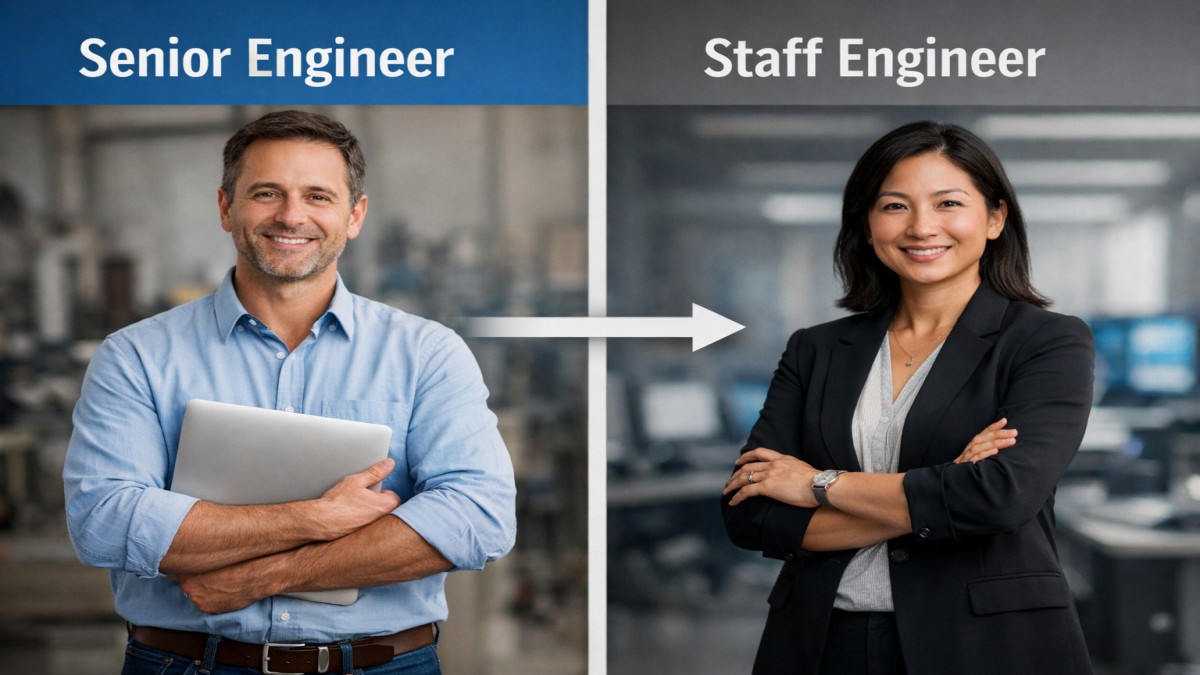
The jump from senior engineer to staff engineer is widely recognized as one of the hardest career transitions in the software industry. Unlike earlier promotions that are primarily driven by growing your individual technical contributions, the staff engineer promotion requires a fundamental shift in how you think about your role, your impact, and your relationship with the organization around you.
Many talented engineers spend years at the senior level wondering what they are missing. If you are in that position, this article will break down what the staff engineer role actually requires and what you can do right now to start building toward it.
The Staff Engineer Role Is About Organizational Impact
At the senior level, you are evaluated primarily on your ability to deliver excellent work within your team. You write high-quality code, design solid solutions for your team’s problems, and contribute reliably to your team’s goals. That is necessary and important work, but it is not what gets you to staff level.
Staff engineers are evaluated on their organizational impact. This means identifying problems that affect multiple teams or the entire engineering organization, designing solutions that work across team boundaries, and driving adoption of those solutions through influence and collaboration rather than authority. The scope of your impact needs to expand significantly before a promotion committee will consider you ready for the staff level.
This is a difficult transition because it requires you to step outside the comfort zone of your immediate team and take on work that is inherently more ambiguous, more political, and more dependent on your ability to work with people you do not directly report to. But it is exactly this ability to operate at a broader scope that defines what a staff engineer does.
Technical Vision and Strategy
Staff engineers are expected to contribute to the technical vision and strategy of their organization. This goes beyond solving the problems that are assigned to you, and it is the same strategic thinking required for engineers considering the transition from IC to management. It means proactively identifying where the technology needs to go, anticipating future challenges before they become crises, and proposing strategic initiatives that align technical investments with business priorities.
Developing this capability starts with building a deep understanding of your organization’s technical landscape and business context. Read the product roadmap. Understand the business model. Talk to product managers and business leaders about what they need from the technology platform. The more context you have, the better positioned you are to identify high-leverage technical opportunities.
If this kind of strategic thinking feels unfamiliar, working with a mentor who operates at the staff or principal level at a top company can help you develop the frameworks and habits needed to think at this level. These professionals can share how they approach technical strategy, how they communicate their vision to leadership, and how they build organizational support for their initiatives.
Influence and Communication
The ability to influence others is perhaps the single most important skill for a staff engineer. You cannot deliver organizational-level impact alone. You need to convince other teams to adopt your proposals, align stakeholders who have different priorities, and navigate the complex interpersonal dynamics that exist in every large engineering organization.
Effective influence at the staff level comes from three sources, all tied to building visibility and executive presence: technical credibility, relationship capital, and communication skill. Technical credibility means people trust your judgment because you have a track record of making sound decisions. Relationship capital means you have invested in understanding what other teams care about and have demonstrated that you consider their needs. Communication skill means you can frame your ideas in ways that resonate with different audiences, from fellow engineers to non-technical executives.
Building these capabilities takes deliberate practice over time. Seek opportunities to present your ideas to larger audiences. Write technical proposals that require buy-in from multiple teams. Volunteer for cross-functional initiatives that put you in rooms with people outside your usual circle. Each of these experiences builds the influence muscle that staff-level work demands.
Preparing for Staff-Level Interviews
Whether you are pursuing a staff promotion internally or interviewing for a staff role at a new company, the evaluation process is intense. Staff-level interviews at FAANG companies include system design rounds that test your ability to architect at massive scale, behavioral rounds that probe for evidence of organizational leadership, and sometimes additional rounds focused on technical strategy or cross-team problem solving.
These interviews require a different kind of preparation than senior-level interviews. Your system design answers need to demonstrate not just correctness but maturity and trade-off awareness. Your behavioral stories need to show impact at the organizational level, not just the team level. And your overall demeanor needs to communicate the kind of calm, confident leadership that hiring committees associate with staff-level readiness.
Practicing with mock interviews conducted by professionals who evaluate staff-level candidates at FAANG companies is one of the most efficient ways to calibrate your performance and identify the specific areas where you need to improve. The feedback from these sessions is targeted and actionable in a way that self-assessment simply cannot match.
Building a Support System for the Journey
The path from senior to staff is not something you should try to navigate alone. The challenges are complex, the timeline is long, and the feedback loops in most organizations are slow. Having external support from people who understand the journey and can provide regular, honest feedback accelerates the process significantly.
Career development platforms like BeTopTen are designed specifically for this kind of transition. They connect you with mentors and coaches from leading tech companies who can help you develop a personalized plan for reaching staff level, hold you accountable to your goals, and provide the kind of detailed, experienced feedback that speeds up your growth.
The investment in this kind of support pays for itself many times over when you consider the financial and professional impact of reaching the staff level at a top company. The difference in total compensation alone can exceed $150,000 to $200,000 per year, and the promotion and career opportunities that open up at this level are fundamentally different from what is available at the senior level.
Becoming a Guide for Others
Once you have made the transition to staff engineer, one of the most valuable things you can do is help others who are on the same path. The senior-to-staff transition is poorly understood by most engineers, and firsthand guidance from someone who has recently made the leap is incredibly valuable to those who are still working toward it.
You can become a mentor on BeTopTen and share your experience with engineers who are actively working toward staff level. The process of mentoring others also reinforces your own skills, deepens your understanding of what it takes to succeed at the highest levels, and strengthens your reputation as a leader in the engineering community.
The Path Forward
The transition from senior to staff engineer is challenging, but it is a well-defined challenge. The skills and behaviors required are known, the evaluation criteria at top companies are documented, and the resources to help you prepare are more accessible than they have ever been. What separates the engineers who make this leap from those who remain at the senior level for years is not raw talent. It is intentionality, strategic preparation, and the willingness to invest in their own growth.
If reaching the top 10% of the engineering profession is your goal, the staff engineer role is a critical milestone on that journey. Start building toward it today with a clear plan, the right support, and the commitment to do the work that this transition demands.
